Reading
At Brambles Primary Academy, we are passionate about inspiring every child to develop a love of reading. We believe that learning to read is one of the most important skills a child will ever learn, as it underpins all areas of learning.
Our aim is for all children to become confident, fluent readers with a strong understanding of what they read. Reading is at the heart of our curriculum, and we are committed to giving every child the best possible start by helping them learn to read as quickly and successfully as possible.
Phonics Teaching
We start teaching phonics as soon as the children start school in Reception. We follow the Little Wandle Letters and Sounds Revised progression, which ensures children build on their growing knowledge of the alphabetic code, mastering phonics to read and spell as they move through school.
As a result, all our children are able to tackle any unfamiliar words as they read. At Brambles Primary Academy, we also model the application of the alphabetic code through phonics in shared reading and writing, both inside and outside of the phonics lesson and across the curriculum. We have a strong focus on language development for our children because we know that speaking and listening are crucial skills for reading and writing in all subjects.
Alongside this, the children are taught the ‘tricky words’ – high frequency words which do not follow the regular phonetic pattern.
The Teaching of Reading after phonics
Once children are able to decode words for reading, we work on children's comprehension skills. We build on the reading strategies and comprehension skills they have already acquired in Key stage 1 to explicitly teach the reading domains. Children take part in daily Guided Reading lessons, which focus on a range of high-quality Fiction and Non-Fiction texts.
| Year 2 | |||||
| Autumn 1 | Autumn 2 | Spring 1 | Spring 2 | Summer 1 | Summer 2 |
| Little Wandle Phonics
|
Fantastic
|
Little penguin rescue
|
How to survive
|
Flat Stanley by Jeff Brown |
The Enchanted Wood by Enid Blyton |
| Year 3 | |||||
| Autumn 1 | Autumn 2 | Spring 1 | Spring 2 | Summer 1 | Summer 2 |
|
A rock is lively
|
The Firework Maker’s Daughter by Phillip Pullman |
A Roman Adventure
|
The science of natural disasters—truth about volcanoes |
Anglo-Saxon Boy
|
BFG |
| Year 4 | |||||
| Autumn 1 | Autumn 2 | Spring 1 | Spring 2 | Summer 1 | Summer 2 |
|
A mummy ate my homework
|
Cinderella of the Nile |
Amazing islands
|
Planet Omar
|
Who let the Gods out
|
The Iron Man
|
| Year 5 | |||||
| Autumn 1 | Autumn 2 | Spring 1 | Spring 2 | Summer 1 | Summer 2 |
|
Varjak Paw
|
Climate Action: The
|
The Jamie Drake
|
Earth Shattering Events Jabberwocky by Lewis Carroll & Caged Bird by Mary Angelou |
Wonder by R.J. Palacio |
The Night Bus Hero by Onjali Rauf |
| Year 6 | |||||
| Autumn 1 | Autumn 2 | Spring 1 | Spring 2 | Summer 1 | Summer 2 |
|
Ghost by Jason Reynolds |
Letters from the Lighthouse by Emma Carroll In Flanders Field by John McCrae |
Holes
|
Black Elk’s journey |
Fly Me Home by Polly Ho-Yen |
Amazing Evolution: The Journey of Life
The British Poem by Benjamin Zephaniah |
Every Guided Reading lesson focuses on at least of our reading domains which are:
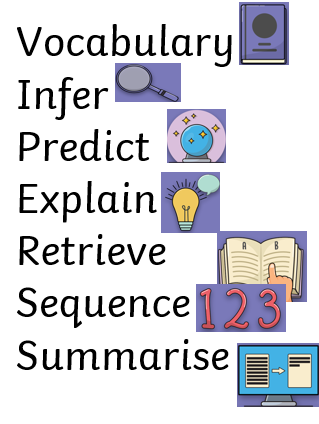
Each domain has skills to success to be able to support children on what to do if they get stuck:
Children are given the opportunities to learn and practise skills linked to the reading domains in a wide variety of ways. Children are taught which reading strategies are most useful for each of the domains and have time to work independently; with a partner; in small groups and as a class.
Please find below documents that show the progression of reading in EYFS and Year 1 to Year 6.
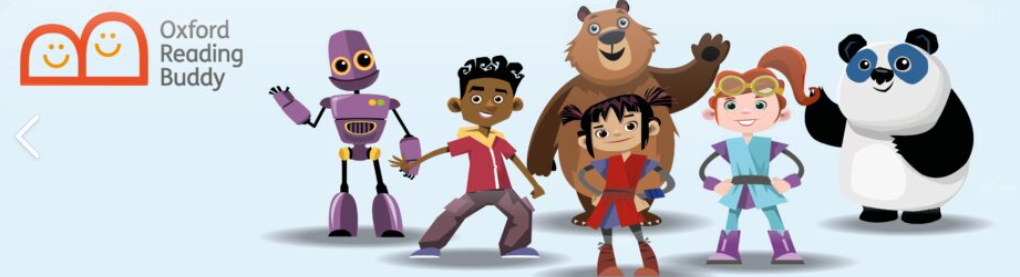
At Brambles, children begin using Oxford Reading Buddy once they have completed the phonics programme. The programme is used regularly, but not every morning, to support children in developing strong reading fluency and comprehension skills at a level that is well matched to their ability.
Oxford Reading Buddy is a fun, digital reading programme that supports children through one‑to‑one modelling and coaching from engaging Reading Buddy characters. Children can choose from a range of interactive characters who spark curiosity, encourage a love of reading, and help them think more deeply about what they read.
With access to over 500 e‑books and more than 1,000 end‑of‑book quizzes, children always have something exciting to explore. The programme automatically moves each child through the Oxford Reading Levels, ensuring books are closely matched to their current ability.